
When it comes to business operations, visibility is critical, and tracking is vital for understanding the status of the vehicles at any point in time. Customers want immediate deliveries and real-time, accurate ETAs, and disruptions to their service can lead to frustration or worse. Delays, fraudulent vehicle use, confusion about which vehicles should take which routes, and a lack of monitoring overwhelm business owners, and the expenses can quickly add up. Insight or lack of it can directly affect the expense of maintaining fleet operations.
Real-time tracking changes the game. Fleet operators can track vehicles in real time and see their positions update as data from the tracking system is processed. Real-time tracking provides a central hub for all current data streams, creating a single point of monitoring as vehicles operate.
Real-time tracking is a vital addition to the tools available to transport, service, delivery, and logistics fleet operators. It allows them to make fast and better posts to their operations and improve or better manage the control associated with their operations.
Understanding Real-Time Tracking Technology
The use of real-time tracking allows fleet operators to access the current location of their vehicles (or their assets or equipment) at any time. Fleet vehicles are equipped with GPS tracking system devices that record and transmit their location to the tracking service via the internet. These GPS tracking devices are constantly updated, providing fleet operators with real-time visibility into internal component movement.
This internal module provides tight location and movement updates. Real time tracking uses the internet, vehicles, and telematic software to provide complete tracking services.
Real Time Tracking for Complete Fleet Visibility
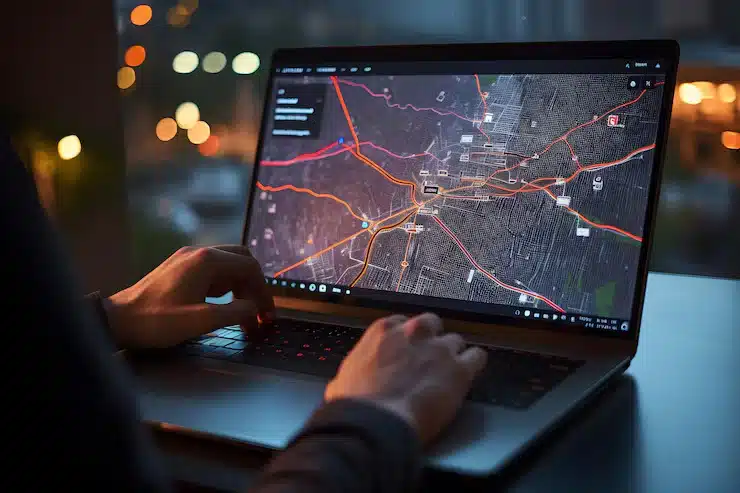
Being able to view the entire fleet is one of the top benefits of real-time trackers. Imagine fleet managers seeing the exact locations of vehicles in real time on digital maps. Moreover most real-time tracking systems show the real-time operational status of each vehicle. These statuses can be operational, stopped, idling and offline.
This means less confusion and a more efficient workflow. Fleet tracking also eliminates the need to call the driver for each decision. Fleet managers can view the entire fleet from a single platform, enabling faster and better decision-making.
Live Route Tracking and Trip Analysis
- Businesses can track the routes in real time. Furthermore, they can monitor whether their drivers are following the plan or taking unnecessary detours.
- Route tracking can show the traffic status, deviations from the plan, unproductive driver behavior and poor plan execution. This improves planning and enhances delivery performance.
- Businesses can use trip summaries to analyze costs and performance, plan better, and review completed trips.
Reducing Operational Costs with Real Time Tracking
- For businesses with vehicle fleets, fuel is one of the largest expenses. By tracking vehicles in real time, businesses can identify issues such as excessive idling, poor driving habits (e.g., speeding), and inefficient routes to minimize fuel waste.
- A reduction in idling results in a direct reduction in a vehicle’s fuel use. A 30-minute reduction in idling time can result in significant monthly fuel cost savings.
- Fewer fuel stops also mean reduced vehicle maintenance. By tracking the vehicle’s engine use (via telematics software), maintenance decisions can be made to avoid breakdowns.
Enhancing Driver Accountability Through Real-Time Monitoring
- Management of a fleet of vehicles can be challenging. Driver behavior directly impacts how well a fleet operates.
- To monitor and discourage poor driving habits (speeding, illegal lane changes, long periods of idling, etc.), fleet managers can use real-time tracking to monitor the fleet and gain insights into each vehicle and driver.
- Drivers at the company will also become more responsible once they know their behavior is being watched. This will lead to better safety, reduced driving violations, and fewer accidents.
Theft Prevention and Vehicle Security
- Losing a vehicle to theft can be very costly. However, real time tracker offers businesses a way to identify theft by sending alerts when a vehicle is moving without authorization.
- If a vehicle is moving when it shouldn’t be, businesses receive alerts. This allows quick action to be taken to recover the vehicle.
- Giving fleet owners peace of mind about safety, protection, and safety compliance, the company’s monitoring system provides real-time protection and safety compliance system offers.
Real Time Alerts, Notifications, and Geofencing
- Up-to-date systems with live GPS technology can help a business track their employees with customized notifications. Managers will be able to track their employees’ speed, stopped activity and ‘off-the-clock’ events, and GPS activity by setting customized notifications.
- Geofencing enables a business to set virtual barriers. An alert will be sent when a vehicle enters or leaves a fenced area.
- Misuse, business control, and operational transparency are all impacted positively by real-time GPS tracking and customizable notifications.
Cloud-Based Dashboards and Mobile Accessibility
- Management can track their employees no matter where they are when they use a web-based tracking system. Because the system is compatible with browsers and apps, access is available at all times.
- Real-time notifications are sent to employees’ mobile devices and desktops.
- The business is able to protect and access its data at any time without complicated processes or installations when using cloud-based telematics software.
Scalability for Growing Fleets
- Real-time tracking systems are important for all business owners. A business owner who is just starting would be able to track just one vehicle, but they would be able to add more vehicles as long as they needed.
- This is beneficial for logistics companies because they can use just one dashboard to track multiple cities and multiple branches.
- This system is designed for a growing fleet because no major changes to existing infrastructure is needed to scale the solution.
Choosing the Right Real-Time Tracking System
- When it comes to choosing a real-time tracking solution, precision is key. Systems with quicker update intervals are better for tracking live vehicles.
- Also, the higher the quality of the reporting and analytics, the better. Things like detailed reports of trips, analysis of fuel usage, and insights of driver performance are worth a lot.
- Lastly, take a look at the system’s software reliability, customer service, and system integration, and support will also be important.
Boost Fleet Efficiency with Real-Time Tracking
1. Advanced GPS Vehicle Tracking Features for Fleet Optimization
- Fuel Management Systems: Monitor consumption patterns and identify driver idling to slash fuel waste.
- Geofencing Technology: Establish virtual perimeters and receive instant alerts for unauthorized location access.
- Driver Behavior Analysis: Track metrics like harsh braking, rapid acceleration, and speeding to reduce accident risks and insurance premiums.
- Route Optimization: Utilize real-time location tracking to ensure delivery confirmation and the most efficient paths possible.
2. Core Fleet Management and Asset Tracking Solutions
- Real-Time Positioning: Instant vehicle location monitoring for better dispatching.
- Asset Tracking: Keep eyes on equipment, cargo, and containers throughout the entire transit cycle.
- Performance Analytics: Combine status reporting with vehicle health data to prevent breakdowns.
By integrating these core services, you streamline decision-making and achieve measurable efficiency gains across your entire logistics network.
3. Reduce Costs and Improve Driver Safety with Real-Time Monitoring
- Identify Efficiency Gaps: See exactly where time and money are being lost.
- Enhance Driver Safety: Monitor and coach drivers against unsafe practices in real-time.
- Lower Operational Expenses: Reducing fuel waste and accident rates directly impacts your bottom line.
Logistics optimization through real-time monitoring doesn’t just save money it improves your service quality and vehicle utilization.
4. The Leading GPS Tracking Provider in Dubai and the UAE
- Regional Compliance: Standards built for Dubai and surrounding emirates.
- Precision Mapping: Advanced location tracking that accounts for local traffic patterns.
- International Tech Standards: Combining local knowledge with world-class vehicle monitoring technology.
Whether you manage a local delivery fleet or international routes, we provide the best-in-class analytics and security protocols required for excellence in the UAE.
Conclusion
Businesses are better at managing fleets due to real-time tracking technology. Accurate, up-to-the-minute information provides fleets with greater control and visibility. The advantages are clear all the way from better driver accountability to reduced fuel costs and prevention of theft.
Strong business performance results from the increased efficiency that reliable vehicle tracking solutions deliver. The real-time tracking technology provides much better control, tracking, and monitoring of assets. Choose Enroute real-time tracking for better control, greater transparency, increased security, and lowered costs are the need for a great real time tracking system.
FAQ's
Real time tracking is a GPS-based technology that allows live monitoring of vehicles, assets, or people using instant location updates through tracking software or mobile systems.
Real time GPS tracking software works by using satellites and IoT devices installed in vehicles or assets. The system sends continuous location data to a dashboard or mobile app for live monitoring.
Real time tracking improves fleet management, enhances security, reduces fuel costs, optimizes routes, and provides complete visibility of vehicles and assets.
Yes, real time tracking is highly effective for fleet management as it helps track driver behavior, monitor routes, reduce delays, and improve operational efficiency.
Absolutely. Real time tracking reduces fuel consumption, prevents unauthorized vehicle usage, minimizes downtime, and improves overall resource management.